
Strangest Shark Adaptions makes For Nature’s Most Bizarre Survival Tricks
Strangest shark adaptations developed over hundreds of millions of years, giving them the opportunity to adapt to nearly every aquatic or marine environment. Many adaptations you may already know include the streamlined body, which lets most sharks swim quickly and easily through the water, and the replacement row of teeth on each jaw, which lets sharks lose a tooth without it harming their hunting ability.
However, some shark adaptations can seem very strange indeed. One example of a strange adaptation is when some sharks are capable of walking on the sea floor; another includes sharks having jaws that snap forward like spring-loaded mechanisms; a third example would be some species that produce their own bioluminescence and use it for hunting; yet another example of a strange adaptation includes sharks that use their tail to catch prey, and the tail is nearly as long as the shark itself; and finally, there are sharks that are capable of detecting electrical signals created by all living things. The most unusual shark adaptations show the importance of understanding shark evolution in relation to the variety of shark designs. Different environments present different challenges. Evolution has provided numerous and innovative solutions.
What Are Shark Adaptations?
Biological Adaptation: An anatomical or physiological trait which has evolved to assist with reproduction and survival for an organism within its specific environment. Shark-specific adaptations may be physical (anatomical), behavioural, physiological, or sensory. These adaptations could help sharks find prey and exploit unique prey sources; avoid being eaten by other predators and camouflage themselves; swim efficiently and save energy; survive with less oxygen available; navigate large bodies of ocean; and reproduce. This helps explain why sharks can have such diverse appearances and behaviours.
A pelagic shark capable of swimming at high speeds would face vastly different survival pressures than a small shark inhabiting the shallow waters surrounding coral reefs. Similarly, a shark that can hunt hundreds of meters beneath the surface will require different senses than a shark in relatively shallow coastal waters with abundant sunlight.
The following unusual adaptations are among the most notable illustrations of how different shark species have evolved to meet different survival challenges.
What Are the Strangest Shark Adaptations in the World?
Some of the most bizarre shark features are so strange they seem like they belong to fictional creatures. However weird or unbelievable they seem, each feature has a function. Different shark species use each one in ways shaped by their environment.
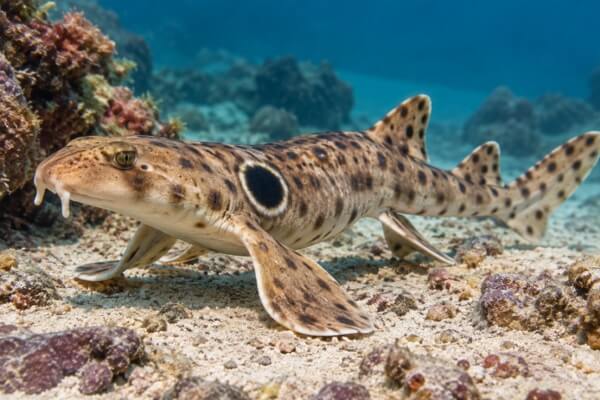
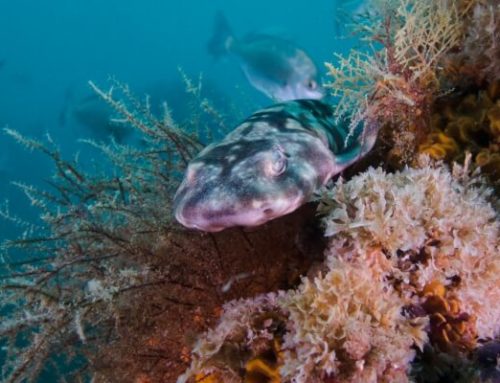
1. Epaulette Sharks Can “Walk”
Epaulette sharks (Hemiscyllium ocellatum) are generally expected to be swimmers; however, they also have an additional mode of locomotion. They use their strong, muscular pectoral and pelvic fins to create a “walking” motion as they move along the substrate. This method of locomotion is especially beneficial when epaulette sharks live in the shallow reef environments they typically inhabit. When tides are low, epaulette sharks often find themselves stranded in isolated pools or extremely shallow water, with little opportunity to use their primary form of locomotion, swimming. They can therefore slide and push through sand and along reef surfaces by employing their fins. Epaulette sharks can also withstand lower levels of dissolved oxygen than most other species. According to Smithsonian Ocean, epaulette sharks can survive for extended periods without access to oxygen and then employ their fins to navigate from one pool to the next.
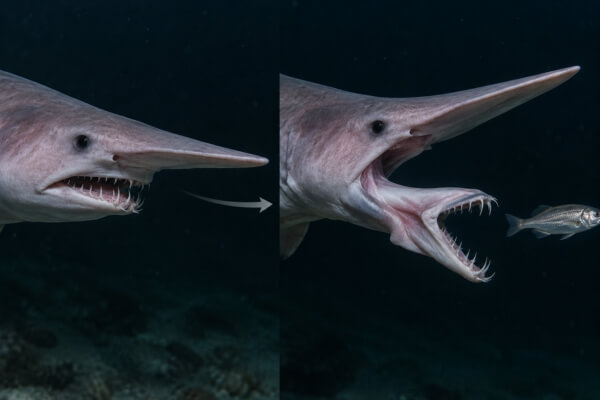
2. Goblin Sharks Can Launch Their Jaws Forward
Few shark species are as unique-looking as the goblin shark (Mitsukurina owstoni). It has an elongated, flattened snout that gives it a distinctive look; however, it also has another strange feature below the snout. The goblin shark has highly mobile jaws. When potential prey is close enough to attack, the shark can quickly thrust its jaws forward from the front of the skull to capture prey, then retract them back into the skull. The shark’s ability to thrust its jaws outward when it encounters prey will be beneficial in the deep ocean because of low food availability and limited opportunities to encounter prey. In addition to sensing prey through electroreception with sensory organs in the lengthened portion of its snout, the shark can also locate prey using this same area.
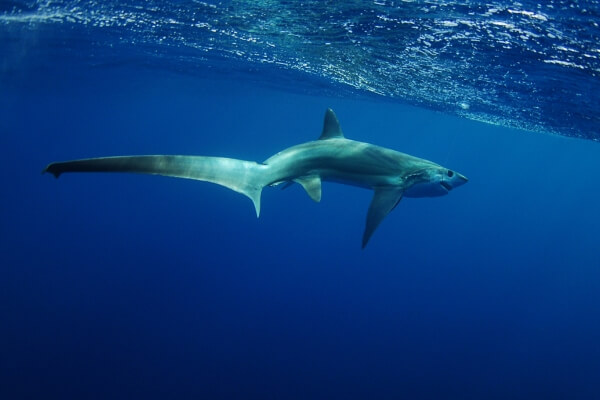
3. Thresher Sharks Use Their Tails as Weapons
Sharks most commonly utilize their caudal fins (tails) for propelling themselves through water. Thresher sharks take this idea to new heights by utilizing an elongated dorsal-caudal fin that accounts for a large portion of the shark’s total body length. Unlike other sharks which are limited in their ability to swim and hunt utilizing their long tails, thresher sharks are capable of swimming and hunting simultaneously.
The method used by thresher sharks to hunt includes approaching schools of baitfish and then swinging their tails in order to create sufficient force to either disorient or incapacitate the target fish; allowing them to be caught individually. Smithsonian Ocean provides examples of how thresher sharks will often herd schools of baitfish prior to attacking and using their long tails to hit the schools from directly above.
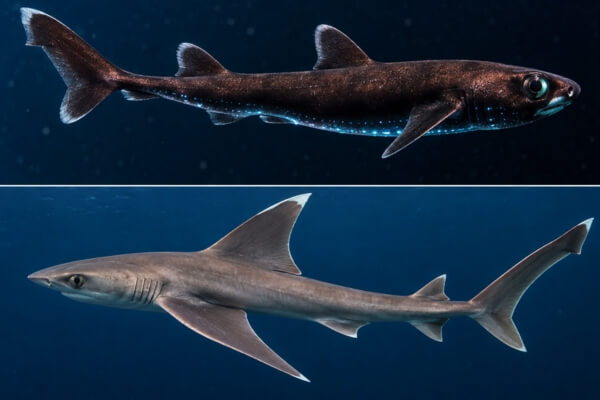
4. Some Sharks Can Produce Their Own Light
Bioluminescence is the ability to make one’s own light. Sharks can do just that. In addition, many sharks have specialised organs for producing light, such as photophores. The purpose of these structures varies based upon the type of shark and includes functions such as camouflage, interaction between individuals (for mating), and interacting with other animals.
One particular function of bioluminescent structures is counterillumination. In low-light environments, an object appears as a dark silhouette because it blocks the faint light coming from above. When an individual produces light under its body (counter-illuminating), it reduces the amount of light blocked by the upper portion of its body. As a result, it makes itself much harder to see than if it were simply trying to remain undetected by being less conspicuous (i.e., appearing less visible).
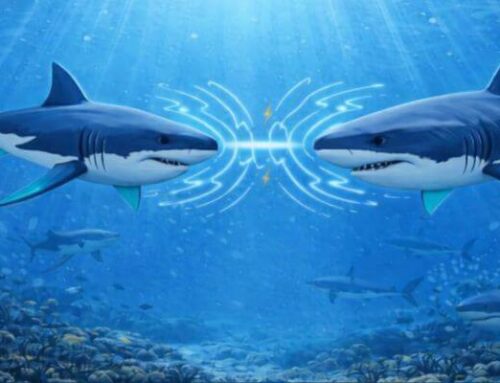
5. Sharks Can Detect Electricity
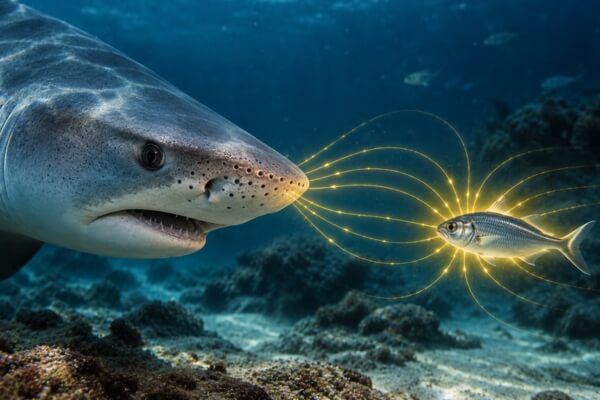
One of the most interesting things about how sharks adapt is found not in their teeth or fins, but in their senses. Sharks sense their environment through small holes (ampullae of Lorenzini) around their heads. All living creatures create an extremely low-level electrical field due to various physical processes (such as muscle and nerve stimulation). Sharks can detect these electrical impulses through electroreception.
Electroreception lets a shark locate a target without seeing it. Even if prey is buried under layers of sand and therefore invisible to sharks, its electrical signature lets the shark locate it.
6. Hammerhead Sharks Turn Their Heads Into Sensory Platforms
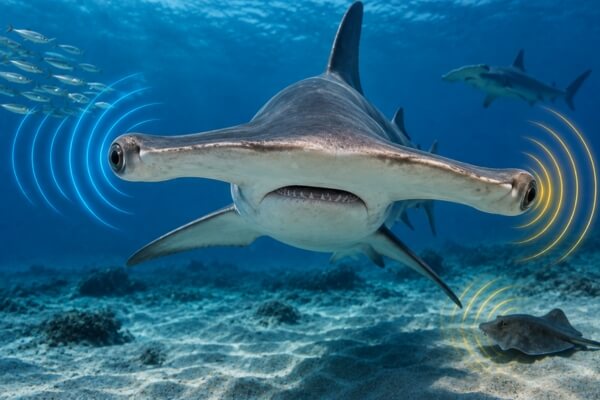
The hammerhead shark’s uniquely shaped head (cephalofoil) is believed to have several key advantages over other sharks. Although that head shape seems strange in nature, it exists for many reasons. The most obvious advantage to having a hammerhead is the placement of both eyes, one on each end of the head, and the sensory pores for electroreception placed around the entire head.
Therefore, because of the large cephalofoil, a larger area is available to detect electrical signals from all directions. This is extremely beneficial to locate prey buried under sediment on the ocean floor. Therefore, rather than an evolutionary anomaly, the hammer-shaped head is a prime example of how a species’ body form has evolved into a specialised tool based on its way of life.
7. Cookiecutter Sharks Take Perfectly Shaped Bites
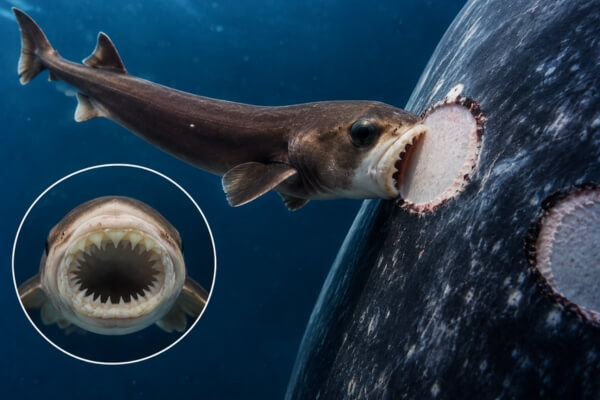
In terms of feeding strategies, although the cookiecutter shark (Isistius brasiliensis) is very small, its feeding strategy may be unique among marine predators. Instead of taking down prey much larger than itself, the cookiecutter shark removes circular pieces of tissue from an animal, which can be either much larger or smaller than the shark.
To do this, the shark attaches its mouth to a larger animal and twists its body. While twisting, the shark cuts through tissue using its specialised teeth. This creates a distinctive, crater-like wound on the target, similar to a cookie cutter cutting rounded holes in dough. Documented examples show that potential targets include both large fish and marine mammals. As such, a small shark like the cookiecutter can consume a significant portion of larger prey, a key adaptation. But the cookiecutter shark’s adaptations don’t stop with how it eats. They are also bioluminescent (they emit light), making them one of the most interesting deep-sea sharks.
8. Shark Skin Is Covered in Tiny Tooth-Like Structures
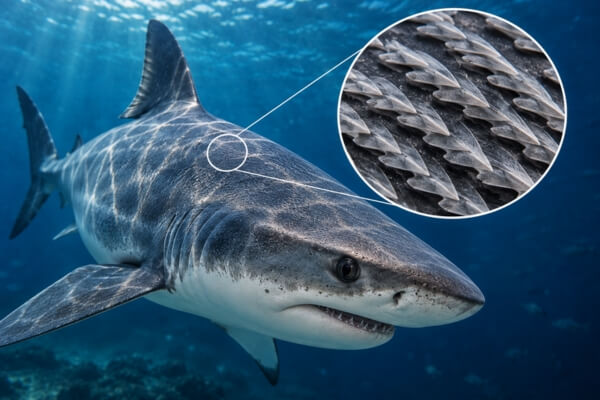
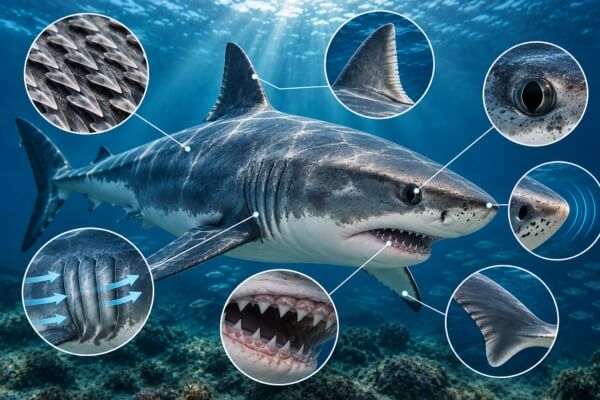
Running your hand down one way over shark skin might feel like you’re running your fingers over very fine sandpaper or thin fabric. If you then move your hand back up, however, it could feel much worse. The reason is simple: sharks have no regular fish scales on their bodies. Instead, they have small, “tooth”– shaped structures called dermal denticles (dental means tooth).
The denticles form rows along the shark’s body. In addition to their “tooth-like” structure, they also have an angle (V-shape) that can influence how water flows past them and across the shark’s outer skin. Dermal denticles provide a similar advantage to swimmers by reducing drag and improving efficiency. Smithsonian Ocean says those same V-shaped placoid scales allow water to slide smoothly over the shark’s skin, reducing friction. One of the less dramatic-looking shark adaptations is probably one of the most beautiful. Shark skin is engineered for life in flowing water.
9. Shark Teeth Are Constantly Replaced
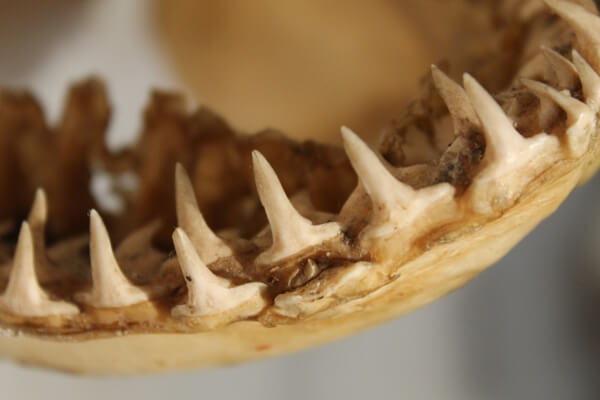
Most predators would suffer greatly if they lost a tooth. Sharks have developed ways to solve this problem. The main solution sharks have developed is to continually replace their adult teeth instead of having one permanent set, as humans do. In addition to producing new teeth, sharks can have multiple sets in each jaw at once. As each row of teeth becomes worn or is damaged (lost), the new set of replacement teeth moves forward to take its place.
Different shark species also have teeth adapted to the types of food they eat. For example, some shark species have teeth shaped and functioning to grip slippery fish. Some shark species have teeth that are designed to cut through meat. Other shark species have teeth that crush large, hard-shelled food items. Lastly, other shark species have long, sharp teeth that let them tear chunks from large animals.
Because sharks are able to constantly generate new teeth by using a process called “replacement”, it is another reason why shark jaws make great eating apparatuses. Instead of protecting every tooth in each jaw for years, the shark simply grows more teeth.
10. Some Sharks Have Spiracles That Help Them Breathe
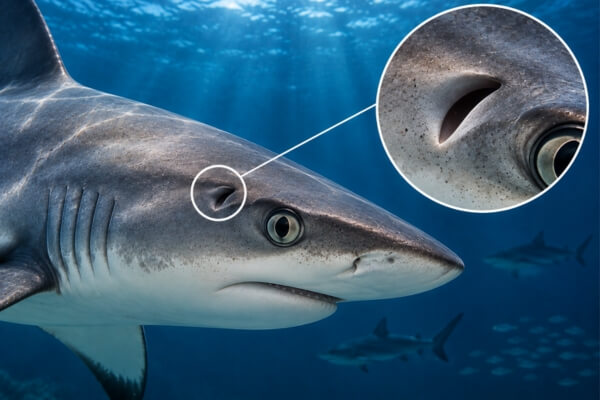
Not all of the world’s sharks cruise the open ocean their entire lives. Some shark species spend extended periods at rest on the seafloor (referred to as bottom-associated). The problem with breathing water that flows into the mouth is that this method of respiration often brings sand and other particles into the shark’s mouth.
A second pathway is provided by spiracles. Spiracles are small holes (located behind each eye) which allow the shark to draw water toward the gills even when the shark is stationary. Many bottom-dwelling sharks have spiracles. While they may not be as dramatic as a glowing body or projecting jaws, spiracles show another example of how shark anatomy has evolved based on their unique way of life.
Why Do Sharks Have So Many Unusual Adaptations?
Sharks come in many different types. These species can be found in a variety of habitats, from shallow, warm waters (tropical) on continents to the open ocean and the bottom of very deep water. Each type of habitat has its own unique challenges. For example, a shark living in very deep water will most likely have enhanced senses and/or bioluminescent abilities. A shark that lives near coral reefs will most likely have strong manoeuvring capabilities and/or the ability to endure harsher environmental conditions than other sharks.
Sharks that live in the open ocean as predators will most likely require greater speed, more efficient swimming, and endurance for longer distances. Natural selection favours traits that help animals survive and reproduce best in their specific environments. As a result of these selective pressures over extremely long timescales (in terms of evolution), we see the diversity of body shapes among modern-day sharks.
Are All Strange Shark Adaptations Related to Hunting?
No. While many unique adaptations help sharks find prey or capture food, they are only a fraction of what helps a shark survive.
Other examples of ways that adaptations are useful to sharks include:
- Camouflage
- Defense
- Efficient swimming
- Navigating through the water
- Respiratory (breathing)
- Conserving energy
- Surviving in low light conditions
- Managing low levels of oxygen
- Reproducing
An adaptation related to feeding can have multiple uses. For example, a sensory system can give an animal information about its environment beyond where it can find its next meal.
What Can Strange Shark Adaptations Teach Us About Evolution?
Shark adaptations show a good example of how natural selection works. Evolution will never create the largest, fastest, or strongest animal. An organism’s traits persist as long as they allow it to reproduce successfully in its environment. This explains the varying adaptations sharks have developed. One species has developed walking legs for traversing shallow substrate. A second has developed bioluminescent capabilities on its belly. A third uses an elongate tail like a pendulum to catch fish. The fourth opens its mouth wide to snap forward.
While these four animals are all classified as sharks, they have many very different ways to find food, avoid predators, and survive in their environment. Therefore, studying shark adaptations can also give scientists greater insight into the connection between an organism’s anatomy, behaviour, habitat, and evolutionary history.
Which Shark Adaptations Are The Strangest?
There likely won’t be an objective, science-based answer to which shark species has the “weirdest” feature, since “strange” or “weird” is subjective when viewed through a human lens. One candidate for one of the weirdest features is the goblin shark’s “projectile jaws.” Another could be the epaulette sharks’ ability to walk on their pectoral fins when crossing from one shallow substrate to another.
Another category that contains some of the coolest sharks (bioluminescence) may also be just as cool. Over hundreds of millions of years of evolutionary history, sharks have developed a wide diversity of adaptations beyond the common image of a large predatory fish with a mouth full of sharp teeth.
See Shark Adaptations in Action in South Africa
While reading on some of the strange shark adaptation is fascinating when it comes to seeing just how specialized some sharks are; watching a shark move freely in the ocean provides a completely new way to view them. South Africa lets us see sharks in their own marine habitat through experiences like shark cage diving in Mossel Bay, where we get close enough to observe shark movement, body form, sensory behaviour, and the adaptations that have allowed these incredible predators to thrive for millions of years.
Whether you would like to learn more about shark biology and now want to experience these creatures first-hand beyond just pictures and facts, or simply want to learn more about our shark cage diving experience in the Garden Route Experience to find out what to expect, how this experience will work and how to prepare for your trip.