
South Africa’s Shy and Curious Coastal Shark
Puffadder Shysharks occur in the kelp forests and rocky reefs off the southern coast of South Africa. As one of the world’s smallest shark species, it has often been overlooked. However, as an important component of these ecosystems, it plays a meaningful ecological role. Learning about species such as the puffadder shyshark helps students and other marine enthusiasts understand the complexity and diversity of our coastal ecosystems.
What Is a Puffadder Shyshark?
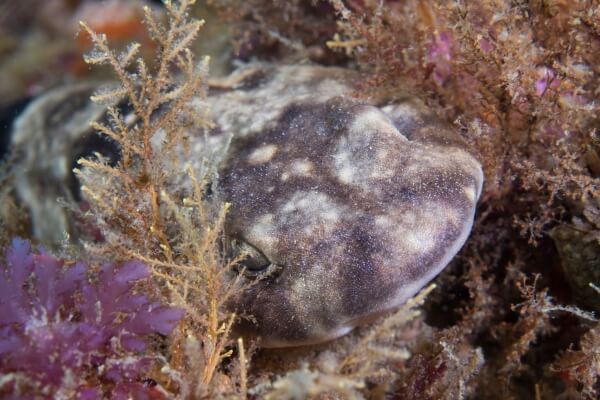
The Puffadder Shyshark (Haploblepharus edwardsii) is a very small species of catshark found only off the Western and Eastern Coasts of South Africa. While shysharks were historically classified under the true catshark family Scyliorhinidae, modern taxonomic revisions have split this group, officially reassigning the genus Haploblepharus into its own distinct family, Pentanchidae. Like other members of this family, these bottom-dwelling sharks are much smaller than large pelagic species and are perfectly adapted for life on the seafloor near rocky reefs and kelp forests.
Why Are They Called a Puffadder Shyshark?
The “puffadder shyshark” has both “puffadder” and “shyshark”.
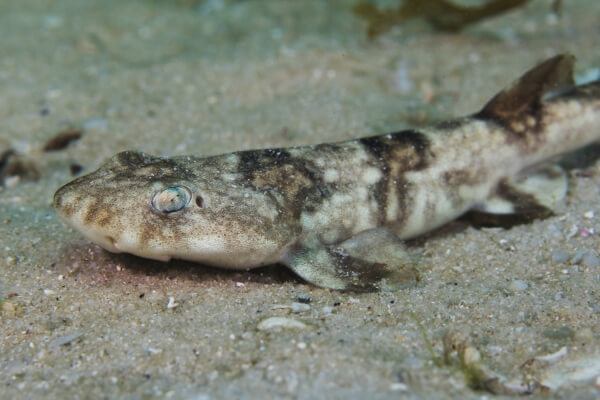
“Puffadder” refers to their striking colour, which looks like the poisonous African puff adder snake. They have a sandy, yellowish-brown body with large, orange-brown, saddle-shaped markings on each side, surrounded by black lines.
“Shyshark” describes how, when they feel threatened, this shark will curl up tightly into a circle and cover its eyes using its caudal (tail) fin. This helps protect the vulnerable area around its head, keeps it rigid and so hard to swallow for predators, and is one of the most recognisable behaviours marine biologists and scuba divers can see.
Where Does these Sharks Live Along South Africa’s Coast?
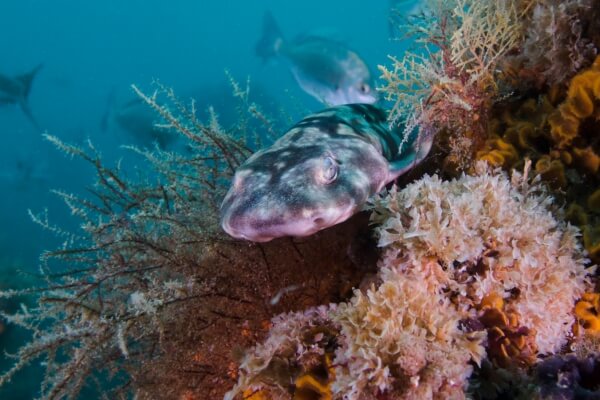
The maximum depth at which H. edwardsii can be found depends heavily on regional ocean currents. In the colder, upwelling waters of the West Coast (such as Langebaan Lagoon), individuals tend to remain close to the surface and in shallow intertidal zones. Conversely, along the warmer East Coast (such as the Mossel Bay and Garden Route areas), the sharks tend to retreat to much deeper, cooler layers further out on the continental shelf, where they can be found at depths of approximately 130 metres.
How Big Does This Shark Get?
The Puffadder Shyshark is much smaller than many other open ocean shark species. Most adult shysharks can grow to be no longer than approximately sixty centimetres. However, some reports describe shysharks reaching up to seventy-nine centimetres.
Shyshark average lengths also vary by geographic location along the south coast of Africa. For example, shysharks that live east of Cape Agulhas in colder waters tend to be shorter, with an average total length of approximately forty-eight centimetres.
When they emerge from their purse-shaped egg case after hatching, new juvenile shysharks are approximately nine to ten centimetres in length. This extremely small body shape suits the evolutionary adaptations they have developed so far. It allows shysharks to slip quietly into narrow crevices, navigate through thick, tall kelp forests, and find safe places beneath boulders or rocky reefs. These same hiding places would be difficult, if not impossible, for larger predators to reach.
Why Is the Puffadder Shyshark Important to Marine Ecosystems?
Whether large or small, sharks are an important indicator of how well our oceans function. The Puffadder Shyshark is particularly important as a mesopredator in the coastal ecosystems off South Africa because it regulates other organisms that live on the ocean floor, such as small bony fishes, polychaete worms, and crustaceans (such as crabs and shrimp). It also serves as a critical linkage between lower-level consumers and higher-level predators like the Cape fur seal, larger cephalopods, and other sharks. Additionally, the puffadder shyshark prevents one prey species from taking over the ecosystem, which is essential for maintaining the diverse communities associated with kelp forests and rocky reef systems. If mesopredators like the puffadder shyshark decline due to excessive bycatch in commercial fisheries, we risk creating an imbalance across the entire system. In turn, this may create a cascade of effects that will result in either the overabundance of some invertebrate species or the complete disappearance of many others.
What Threats Does the Puffadder Shyshark Face?
Although the Puffadder Shyshark does have a limited commercial fishery that is directed at other species, its very small population is under extreme threat today due to many aspects of modern fishing practices:
- Commercial and recreational by-catch: As this shark dwells near the seabed where large numbers of commercial target species do so, it can be incidentally caught with beach seine nets, gillnets, trawls and rock lobster pots. The Puffadder Shyshark is often caught using hook and line by recreational shore-based fishermen who will sometimes kill them if they appear to be stealing their bait.
- Habitat degradation in inshore waters: Both habitat types support Puffadder Shysharks. Temperate rocky reefs and kelp forests are fragile and are being further degraded by coastal urbanisation and pollutants entering the ocean through stormwater run-off from urban centres, as well as increasing marine heat waves associated with global warming.
- Highly restricted range: Their range is confined to a narrow strip along the south coast of South Africa; therefore, they cannot move to avoid localised environmental catastrophes such as oil spills or overfishing.
How Can You Identify This Shark Species?
If you’re snorkelling around shallow reefs or examining tidal pools near the coast in South Africa, look for these three characteristics that can help you determine if what you see is an individual of a Puffadder Shyshark (“Happy Eddie”) as described by divers who have seen them locally.
- The “Snake” Pattern: Their golden-brown or light brown body features seven very visible saddle markings that are either bright orange or reddish-brown, each bordered with a darker shade of brown.
- White speckling: The space between the saddles is covered with many small, white dots.
- Flattened Head & Cat Eyes: Their heads are very flat and end in a long, thin point. Their eyes are also distinctive: long ovals that resemble a cat’s.
- Small: They are generally short and slim, usually no longer than sixty cm.
- Doughnut roll: When frightened, they will curl up into a ball, so that all parts of their body, including their tail, are wrapped tightly together, and all of their eyes are hidden behind their tail fins.
Puffadder Shyshark vs Other Coastal Sharks
| Shark Species | Average Adult Size | Primary Habitat Niche | Diet & Trophic Level | Active Times |
|---|---|---|---|---|
| Puffadder Shyshark |
~60 cm |
Only lives on the bottom of the ocean (benthic)in kelp forests and in shallow crevices of reefs. |
Benthic mesopredator-eats worms, small crabs & tiny fish. |
Primarily hunts at night |
| Broadnose Sevengill Shark |
Up to 3 meters |
Rocky reefs at 10- 20 m depth & dense kelp forests. |
Apex predator-hunts marine mammals, octopus & smaller sharks. |
Opportunistic (hunts day & night) |
| Spotted Ragged-Tooth Shark |
Up to 3.2 meters |
Coastal caves, shallow reefs, sandy channels. |
Mid-to-high predator; eats reef fish, small rays, squid. |
Nocturnal & crepuscular (twilight hunter) |
| Copper Shark |
Up to 3.3 meters |
Pelagic zone-surf zones near beaches; follows schools that migrate. |
High-level predators-hunts schools of sardines & squid. |
Diurnal (highly active during the day). |
Discover More About South Africa’s Sharks and Tidal Pool Sharks
While the Puffadder Shyshark (Haploblepharus edwardsii) may not be the largest or most well-known of the many shark species found in South African coastal waters, it is certainly an example of the great biodiversity that exists in these same coastal waters. This species’ shy behaviour, its ability to curl into a protective ball when threatened, and its dependence on coral reefs and other underwater features make it a fascinating subject for students and ocean enthusiasts alike.
If your interest in learning about small coastal sharks has encouraged you to explore the marine life of the Garden Route region further, we encourage you to read our blog about sharks found in Mossel Bay for information about sharks in Mossel Bay and other shark species in the area. Learn how the many different ocean predators found in South Africa’s oceans, including the smallest fish that live on the coral reefs and the biggest predator at the top of the food chain, all work together to keep the balance of the marine ecosystem.