
Sailback Houndshark: Scientific Insights Into a “Lost” Shark Rediscovered After 50 Years
The sailback houndshark (Gogolia filewoodi) was once considered a “lost species” – a shark formally described by scientists but not seen in the wild for over 50 years. Its rediscovery is a powerful reminder that we still don’t fully understand the ocean. Large parts of marine biodiversity remain undocumented, understudied, or overlooked. What makes this shark even more interesting is that it’s the only known species in the genus Gogolia, meaning it represents a unique evolutionary lineage.
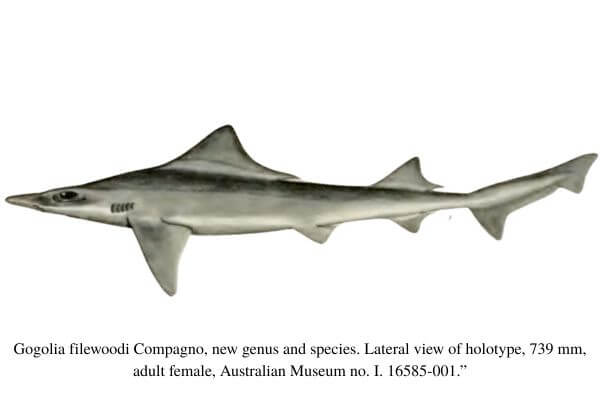
Taxonomy and Classification
The sailback houndshark belongs to a group of sharks characterised by slender bodies and bottom-dwelling behaviour.
- Scientific name: Gogolia filewoodi
- Order: Carcharhiniformes
- Family: Triakidae (houndsharks)
- Genus: Gogolia (only known species)
Because it is the sole member of its genus, the sailback houndshark is particularly important for understanding shark evolution and biodiversity.
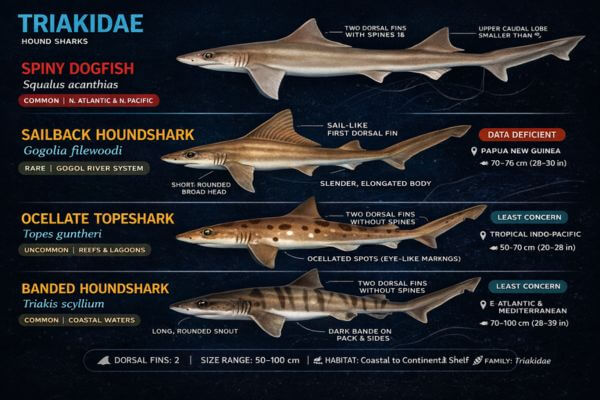
How Was the Sailback Houndshark First Discovered?
The species was originally described from a very limited number of specimens, including a pregnant female collected in 1970 near the mouth of the Gogol River in Papua New Guinea, in an area known as Astrolabe Bay.
Like many shark species, it was classified using morphological taxonomy, where identification is based entirely on physical characteristics rather than observed behaviour. Scientists were able to describe what the shark looked like – but beyond that, very little was known.
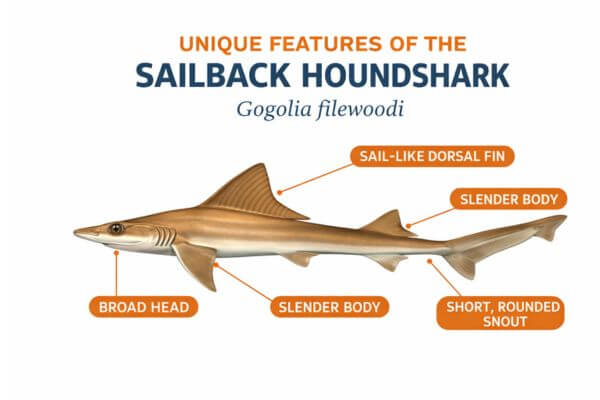
Physical Characteristics of the Sailback Houndshark
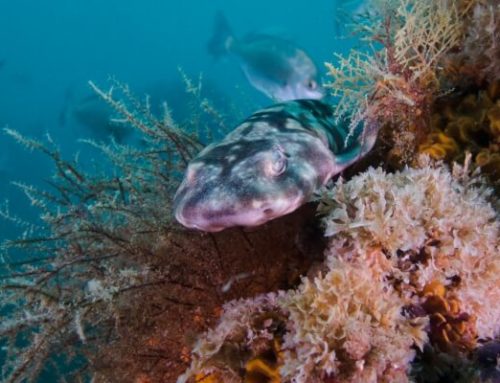
The sailback houndshark has several unique physical characteristics that distinguish it from other houndsharks, which were identified by scientists even before the species was observed again in the wild. Some of these include:
- A dorsal fin shaped like a “sail”; the first dorsal fin has a very long base (which is unusual for a houndshark)
- A narrow, elongated body, similar to most other houndsharks
- A relatively broad head with noticeable eyes
- A short snout and a small mouth
- A cartilaginous skeleton, like all sharks
These features may seem subtle, but they were enough for scientists to recognise the species as distinct from other houndsharks.
Why Did The Sailback Houndshark Remain Unseen?
The combination of ecological characteristics and limitations within marine research helps explain why a species such as this could go unnoticed for so long.
How Big Is The Sailback Houndshark?
Based on the few known specimens, the sailback houndshark is a relatively small shark.
- Females: around 74–76 cm total length
- Males: around 73 cm total length
Compared to many other shark species, this makes it a smaller, more discreet predator – which may also help explain why it went unnoticed for so long.
Importance of Ecological and Sampling Factors in Identifying A Species:
Geographic Isolation
Most of the Western Central Pacific, particularly around Papua New Guinea, is remote and not easy to access.
Sampling Bias
Research on marine ecosystems often takes place in areas that are easier to reach or have greater economic importance, while large parts of the ocean – especially benthic environments – remain poorly studied.
Low Probability of Encounter
If a species exists in low numbers or has a restricted geographic range, it is less likely to be encountered.
Cryptic Morphology
Many houndshark species look very similar, which makes identification difficult without detailed analysis.
Limited Taxonomic Detail in Fisheries Data
Fishing records usually group species into broad categories (e.g. “houndshark”) rather than identifying the exact species.
Benthic Lifestyle
The sailback houndshark is likely found close to the seafloor, which means it stays largely out of reach of most observation methods.
Taken together, these factors make it much easier to understand how a species can remain almost invisible to science for decades.
A lack of observations does not mean a species is extinct – it may not have been seen.
Rediscovery In Papua New Guinea
Between 2020 and 2022, there were reports of individuals of the shark species Gogolia filewoodi. This species had not been seen for many years since its original discovery. Gogolia filewoodi was recorded in Papua New Guinea, an area that forms part of the Coral Triangle.
The Coral Triangle is known for having one of the highest levels of marine biodiversity on the planet. There is a vast amount of marine life in these waters; however, the region has not received much scientific attention. As a result, many species remain either unknown or unrecorded.
It was local fishermen who first recognised that something about the sharks they were catching seemed different from the others. At first, they couldn’t clearly explain what it was – the sharks just looked different.
When scientists examined the sharks more closely, they began to identify the differences. These included:
- A distinctive dorsal fin shaped like a sail
- A slender body form typical of houndsharks
- Fin placement that matched the original species description
- Subtle morphometric differences are used to distinguish it from related species
When researchers compared the six sharks to the original type specimen, they confirmed that the sharks were Gogolia filewoodi.
Of the six sharks recorded:
- Five females were documented in 2020
- One male was documented in 2022 – the first male ever recorded for the species
The Role Of Local Knowledge In Rediscovery
It is interesting to note that some local fishermen have been aware of this shark species for many years. Some stated they had caught it from time to time while fishing for other species, particularly at certain times of year.
This highlights the fact that scientific research does not happen in isolation. It often relies on the knowledge of people who live and work in the area. Local knowledge can play an important role in helping researchers identify and better understand species that might otherwise go unnoticed.
Validation Of The Rediscovery
Verifying the rediscovery of a species is not as simple as recognising it. It is a careful process that requires multiple steps to ensure the species has not been misidentified.
Scientists used a variety of methods to confirm the identification of the sailback houndshark. These included:
- Comparative morphology – comparing the physical characteristics of the specimen to the original species description
- Meristic analysis – counting features such as fin rays and vertebrae
- Morphometric analysis – measuring body proportions and ratios
- Comparison to museum specimens – matching the specimen to preserved type specimens
- Independent peer review – verification of the findings through publication in a peer-reviewed journal
Once all these steps were completed, scientists were able to verify the rediscovery confidently.
Habitat And Ecology Of The Sailback Houndshark
There is still limited information about the sailback houndshark, and scientists don’t yet fully understand many aspects of its ecology. That said, based on what we do know, we can make some reasonable assumptions about where it lives and the role it plays in the ocean.
Likely Habitat
The sailback houndshark is thought to live mainly along the continental shelf of the Western Central Pacific Ocean, especially around northern Papua New Guinea. Most recorded sightings have been at depths of around 70 metres. However, some individuals have been found at greater depths along the continental slope, at roughly 200 metres.
These areas usually have soft seabeds made up of sand or mud, which are:
- Difficult to study
- Poorly mapped
- Often overlooked in long-term research
Ecological Role
As a mesopredator, the sailback houndshark likely feeds on smaller animals while also being prey for larger predators. Even though it isn’t an apex predator, it still plays an important role in maintaining ecosystem balance.
Feeding Behaviour and Diet
Members of the Triakidae family typically spend most of their time foraging at the bottom.
The diet of the sailback houndshark is likely made up of:
- Small fish that stay near the bottom
- Crustaceans such as crabs and shrimp
- Worms and other small animals found in the sediment
The sailback houndshark finds its prey by:
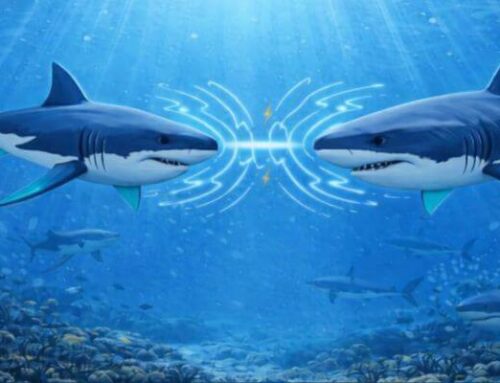
- Electroreception (ampullae of Lorenzini) to detect the electrical signals of its prey
- Using a highly developed sense of smell
- Either sucking up prey with its mouth or capturing prey in its jaws
This matters because:
Bottom-dwelling organisms are regulated by the sailback houndshark feeding on them.
While this may seem unimportant, it has a significant impact on maintaining the balance of seabed ecosystems.
Behaviour and Adaptations
Even though no one has directly observed this shark in the wild, its body structure gives us strong clues about how it behaves.
Behaviour:
- Likely demersal (bottom-associated)
- Slow-moving and energy-efficient
- Non-aggressive
- Not territorial
Adaptations:
- Its sail-like dorsal fin may help stabilise movement along the seabed
- Its streamlined body reduces energy use
- Its colouring likely provides camouflage against the ocean floor
All of these traits point to a shark adapted to a quiet, low-energy life on the seafloor.
Reproduction Of The Sailback Houndshark
Although there are no documented cases of reproduction in the wild, the first recorded individual of the sailback houndshark (Gogolia filewoodi) was a pregnant female containing two embryos at distinct developmental stages.
The presence of these embryos suggests that the sailback houndshark is most likely ovoviviparous (i.e., live-bearing) and produces few offspring per litter (estimated to be about two). Populations with lower reproductive output are typically more vulnerable to decline due to overfishing and/or habitat disturbance.
Potential Threats To The Sailback Houndshark
Because of limited data, assessing the full range of potential threats to the sailback houndshark is difficult. However, likely threats include:
- Capture in commercial fishing gear (bycatch), as well as disturbance to its benthic habitat
- Low reproductive rate of the species
Classification And Significance Of The Sailback Houndshark
Based on current IUCN Red List criteria, the sailback houndshark is classified as “Data Deficient.” This means there is currently insufficient data to assess:
- Population size
- Distribution
- Population trends
The species’ rediscovery highlights the need for further research – both to improve our understanding of the species and to identify ways to protect it if necessary.
Quick Facts: Sailback Houndshark
- Scientific name: Gogolia filewoodi
- Family: Triakidae (houndsharks)
- Order: Carcharhiniformes
- Genus: Gogolia (only species)
- Habitat: Continental shelf waters of northern Papua New Guinea
- Depth: Around 70 metres
- Diet: Small fish, crustaceans, worms
- Reproduction: Ovoviviparous (live-bearing), ~2 offspring
- Status: Data Deficient
- Rediscovery: 2020–2022 (first male recorded in 2022)
Why Was It Not Observed Earlier?
The rediscovery of the sailback houndshark shows just how much of the ocean remains unexplored. Large areas remain unmapped, and even where research exists, scientists are constrained by time, resources, and access. Some species are hard to find. If they occur in small numbers or in specific habitats, the chance of encountering them is very low. Fishing records don’t always help either – many species are grouped without detailed identification. And benthic species, like this one, are especially easy to miss because they live away from surface observation methods. When you consider all of this, it becomes clear how a species can remain unseen for decades – even while it continues to exist.
What The Sailback Houndshark Teaches Us
The sailback houndshark is a reminder that the ocean still holds many unanswered questions. Species we once thought were gone may still be out there, living in places we haven’t explored closely enough. As research continues, we’ll gradually fill in these gaps and gain a deeper understanding of just how diverse life in the ocean really is. From the lesser-known sailback hounds to the most well-known sharks in the ocean, South Africa offers a great chance to see many different types of sharks. The experience of seeing sharks in the wild is unmatched by any other experience, except learning about them. Come learn why Mossel Bay is a top place in the world for getting face time with marine animals, and also find out why Mossel Bay is so special for all you ocean enthusiasts.