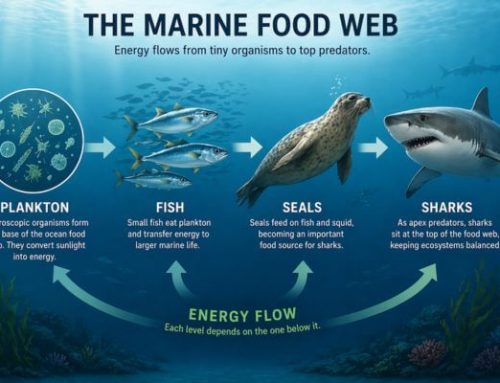

Why Sharks Circle Boats When Investigating Their Environment
Sharks circle boats and remain among the most enigmatic marine species. People tend to feel scared when they witness a shark slowly circling a boat, but the situation is far more complex than they expect. Circling behaviour serves as a way for apex predators to gather information as they study movement patterns and evaluate the current state of their territorySharks circle boats and remain among the most enigmatic marine species. People tend to feel scared when they witness a shark slowly circling a boat, but the situation is far more complex than they expect. Circling behaviour serves as a way for apex predators to gather information as they study movement patterns and evaluate the current state of their territory.

Why Do Sharks Circle Boats?
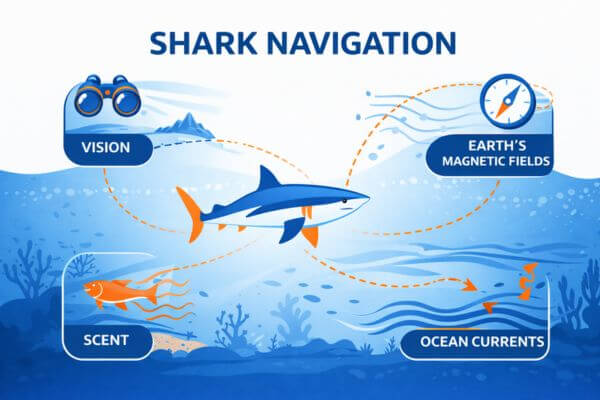
Circling is a natural behaviour. Sharks swim in circles around boats to gather sensory information via electroreceptors, assess moving objects entering their territory, search for food, and detect changes in water pressure from the boat.
Sharks circle the boat, which is a circular movement, is an investigative behaviour rather than an aggressive one. Sharks are ocean predators that exhibit natural curiosity. Sharks follow the same exploration pattern when encountering new objects in their environment as humans do when investigating unusual sounds at home.

Do Sharks Circle Boats Because They Are Hunting?
Not automatically.
Sharks feed opportunistically, but their solo circular movements do not indicate hunting behaviour. Sharks perform direct, consequential, and explosive movements during hunting. Slow circling is a behaviour that allows sharks to inspect their surroundings.
Signs a shark is not hunting:
Slow, relaxed, controlled swimming
Wide, even loops
No sudden acceleration
No change in fin position
Apex predators conserve energy because they only attack when they are confident of the reward.

Are Some Shark Species More Likely to Circle Boats?
Yes. The following species commonly show this behaviour pattern:
Great White Shark
The species demonstrates careful exploration behaviour. The sharks enter the area slowly, then make one or two circular movements before leaving.
Copper Shark (Bronze Whaler)
The shark demonstrates high intelligence by visiting boats during times when fish are present in the area.
Oceanic Blacktip
The sharks have a strong reaction to both motion and vibration, which increases their likelihood of inspecting boats.
Tiger Shark
The shark shows intense curiosity, leading it to linger around boats for extended periods.
Blue Shark
The species of blue sharks in offshore areas tend to circle drifting or chumming vessels.
What Scientists Believe About Shark Navigation
Research indicates that sharks depend on Earth’s magnetic field to navigate over long distances. The circular motion helps sharks maintain their internal navigation system. Multiple shark species demonstrate this behaviour during their extensive migration patterns, particularly the great white shark. Scientists have observed sharks performing circular patterns around research vessels before they depart in a specific direction.
What Does a Shark’s Body Language Mean?
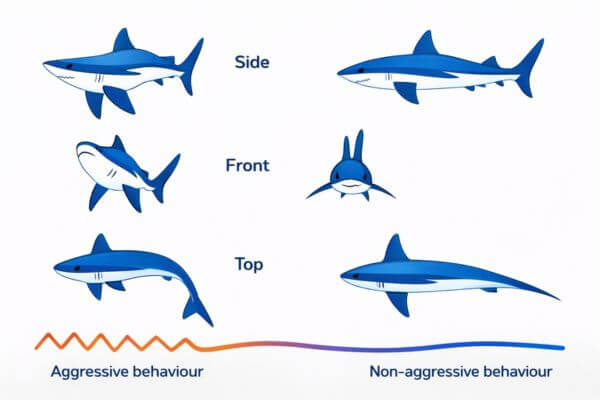
The ability to read shark body language enables you to correctly understand their circular movements.
Calm investigation
- The tail moves at a constant pace while performing smooth beats
- The shark moves at a slow pace through the water
- The shark maintains a flat back position
- The shark keeps its fins in a relaxed position
The shark shows rising interest through its circular movements, which become tighter as it approaches and surfaces more often.
Agitation (rare)
- The pectoral fins of the shark point toward the bottom of the water
- The shark maintains a stiff body position
- The shark exhibits irregular swimming patterns, occasionally speeding up.
Most circular movements in sharks are driven by curiosity rather than aggression.
Do Sharks Attack Boats?
Very rarely.
Most shark incidents that result in boat contact stem from three main reasons:
- Mistaken identity
- Investigation
- Competition during the fishing activity
Sharks fail to recognise boats as their natural prey. A marine hunter would not benefit from attacking fibreglass material.
Great whites have shown interest in motor parts because these components produce electromagnetic fields, which stimulate their curiosity. The shark performs an exploratory bite rather than exhibiting predatory behaviour.
Why Do Sharks Swim Slowly Around Cage-Diving Boats?
The shark population at Mossel Bay has learned to recognise boats because they detect fish smells, follow chum slicks, observe water movement, and show interest in moving objects. The sharks that visit cage-diving sites at Mossel Bay use circling behaviour to study their surroundings and track underwater movements. They approach from positions where their visual abilities are strongest. The sharks display observational behaviour rather than any signs of aggression.
Are Sharks Attracted To Engines, Vibration, or Sound?
Sharks possess highly sensitive lateral lines, which enable them to detect:
- The lateral lines of sharks detect low-frequency vibrations, water-pressure changes, engine pulses, and the movements of humans and other fish.
- The natural vibrations from boats attract sharks. Circular motion helps sharks locate the source of these vibrations.
Is Shark Circling Dangerous for Humans?
Shark circling behaviour does not indicate any danger to humans. The statistical evidence shows that sharks exhibit more curiosity than aggression. The way humans perceive danger stems from Hollywood, as movies frequently depict circling as a warning sign before an attack, although this rarely happens in reality. Multiple times per week, South African divers, researchers and cage-diving teams witness sharks performing circular patterns without facing any threats.
How To Behave If You See a Shark Circling Your Boat
Sharks circle the boat. Marine researchers provide the following safety recommendations:
- Maintain composure; any sudden movements will pique their interest.
- All water contact should be avoided by keeping hands and objects submerged.
- All non-essential vibrations need to be disabled by not starting the engine.
- Fish scraps should never be discarded into the water. Witness the encounter from a protected area because it creates an amazing experience.
- People should never try to touch or pat the shark during its encounter.
The shark will circle before deciding to leave the area.
Sharks Circle Boats Out of Curiosity, Not Aggression
The marine world includes sharks that swim around boats, one of its most confusing animal behaviours. The behaviour of sharks swimming around boats reflects their natural curiosity and need to explore their environment and find their way.
Experience Real Shark Behaviour in Mossel Bay
The sight of a shark swimming around a boat is captivating, but witnessing it firsthand creates an experience that stays with you forever. The coastal waters of Mossel Bay offer a unique opportunity to observe great whites and copper sharks in their natural environment, under the guidance of marine experts who understand their behaviour.